Naval Competition in South Asia and the Limits of Confidence Building Measures
Naval competition in South Asia is closely connected with the geostrategic realities in the region. In the sub-continent, this is especially so for India and Pakistan. They are maritime as well as continental neighbours who depend on the seas for much of their imported energy needs and almost all their external trade. Sea lines of communications (SLOCs) are vital for them individually at all times, but even more so the protection of one’s own sea lines and being able to disrupt the other’s lines in times of conflict. Further, both have nuclear weapons. India now has a growing nuclear powered ballistic missile submarine (SSBN) fleet while Pakistan seems to be on the threshold of deploying shorter range nuclear-tipped cruise missiles with their planned inductions of Chinese conventional submarines.
In this policy brief, Sudarshan Shrikhande argues that within the Indian subcontinent, India’s situation is more complex than for many other countries. From India’s perspective, there have been two ever-present geo-strategically significant factors affecting its maritime strategy – Pakistan and China. They are not only continental neighbours, but Pakistan is an immediate maritime neighbour and China is a de facto maritime neighbour. It examines the maritime and continental conundrum that Indian statecraft has to deal with. To this complexity, one should also add the deep China-Pakistan relationship. This is a decades-old partnership that is in many ways closer, more coherent and likely to be more enduring than some of the “special relationships” between the United States and its formal allies, including the United Kingdom.
In focusing on the maritime security environment, the author considers escalation scenarios from the South Asian naval competition in the nuclear as well as conventional dimensions. He examines three related questions:
- Whether these scenarios are likely to be further complicated by emerging technologies:
- Do existing confidence building measures address likely concerns in the maritime domain.
- Could other confidence building measures (CBMs) be developed for the South Asian maritime domain?
The policy brief also looks at larger issues of leadership consistencies and inconsistencies, and the political drivers for particular diplomatic-military behaviour that have much greater influence than the relatively fragile guardrails that CBMs provide.
Shrikhande concludes that CBMs are often viewed as vital “guardrails” and have existed between India and Pakistan for decades, but they are not foolproof. The central challenge to regional stability in South Asia is not the lack of modern or comprehensive CBMs but the proclivity of political and military leaders to engage in “nuclear rattling” and their willingness to bypass established agreements when it suits their strategic or personal preferences. He recommends that:
- Maritime and continental security are inseparable. Especially for India, the land and sea domains are strategically linked and cannot be viewed in isolation.
- Agreements are frequently broken or ignored due to the changing political climate or the unpredictable logic of those in power. To be truly effective, treaties and agreements must be reinforced by robust rules of engagement (ROE), prudent directives from political and military leadership, and sound judgment from commanders “on the spot” who must manage real-time incidents.
- More communication is not always better. For instance multiple hotlines can lead to “crossed wires” and confusion. In volatile situations, point-to-point military communications centralised through a military headquarters can be more effective. Existing hotlines should also be tested occasionally to ensure that they remains functional.
About the Author
Sudarshan Shrikhande is a former flag officer of the Indian Navy, with varied naval joint forces and diplomatic experience during his career of 36 years. Since 2016, he has been engaged in teaching and writing and participated in various international and national conferences, Track 2.0 engagements. He is a graduate of the Soviet Naval War College (1985); Indian Staff College, (1995); Indian NWC (2002); US NWC (2003). Apart from earlier masters’ degrees, he has an MPHIL and a PHD (on Nuclear Deterrence) from Mumbai University. He is an adjunct professor at the IN Naval War College, Goa; editor-in-chief of the IN Despatch; Distinguished Fellow, Australia- India institute, University of Melbourne.
The opinions articulated above represent the views of the authors and do not necessarily reflect the position of the Asia-Pacific Leadership Network or any of its members. The APLN website is a source of authoritative research and analysis and serves as a platform for debate and discussion among our senior network members, experts and practitioners, as well as the next generation of policymakers, analysts and advocates. Comments and responses can be emailed to apln@apln.network.
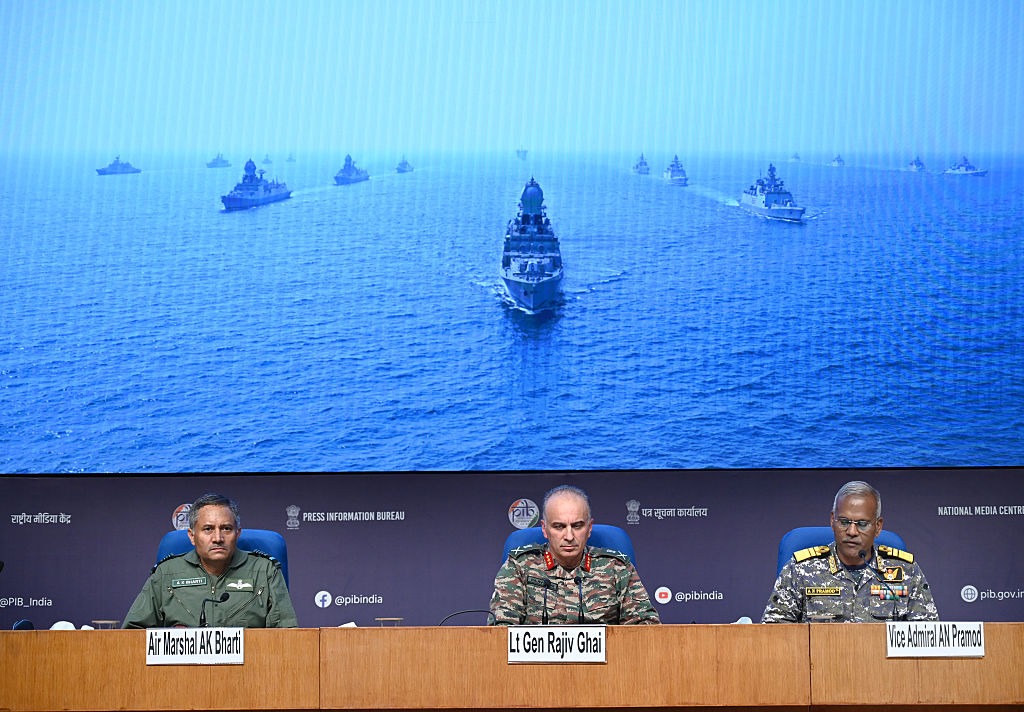
Image: Press Conference Of DGMO Lt General Rajiv Ghai, DGAO Air Marshal AK Bharti, DGNO Vice Admiral AN Pramod On ‘Operation Sindoor.’ (Hindustan Times via Getty Images).