Non-SSN Anti-Submarine Warfare Capabilities of the ROK and Japan
Sanghoe Lee assesses the non-SSN anti-submarine warfare (ASW) capabilities of the Republic of Korea (ROK) Navy and the Japan Maritime Self-Defence Force (JMSDF), drawing on publicly available information on their organisations, platforms, sensors, supporting assets, procurement trends and institutional arrangements. Rather than comparing individual platforms or the absolute number of ASW assets, the paper considers how differences in maritime geography, operational requirements and strategic environments have shaped the two navies’ approaches to ASW.
Key findings
- The JMSDF’s ASW capabilities are assessed as superior to those of the ROK Navy, but the gap is most evident not in frontline platforms but in supporting infrastructure: wide-area seabed acoustic surveillance networks, specialised intelligence collection assets, institutional structures that feed acoustic and oceanographic data back into tactical doctrine, and accumulated proficiency in ASW operations.
- South Korea’s ASW transformation began in earnest after the sinking of ROKS Cheonan in 2010. Before that, the ROK Navy used the same sonar systems across three successive destroyer classes from 1996 to 2011, making no improvement in sonar capability even as it achieved substantial advances in air defence and strike. After Cheonan, the Navy reinforced existing vessels and designed new ships with significantly improved sonar, including integrated low-frequency active systems.
- Japan, by contrast, has accumulated ASW capability for half a century. During the Cold War, the JMSDF assumed the mission of forming an ASW barrier against the Soviet Pacific Fleet, and this role shaped its fleet organisation, ship design and training from the outset. The result is a navy in which ASW is not a specialist function but a structural principle.
- Both navies face the same future pressures: quieter adversary submarines, expanding areas of responsibility and shrinking personnel pools due to demographic decline. Both are pursuing broadly similar solutions, including multistatic detection, AI-enhanced signal processing and uncrewed underwater vehicles, but Japan is further advanced and is extending its efforts into international cooperation, including a joint feasibility study with Airbus on ASW-capable unmanned aircraft.
- The ROK Navy operates only six P-8A Poseidon maritime patrol aircraft, and uncertainty over future procurement means it may need to develop an indigenous replacement. Japan’s domestically developed P-1 fleet is far larger, but a Board of Audit report found that a considerable number of deployed aircraft faced restrictions on mission performance due to engine and equipment defects.
About the Author
Sanghoe Lee is a security expert specialising in international relations and law. He graduated from the ROK Naval Academy (including two years in the Japanese National Defense Academy) and received an LLM from Korea Maritime and Ocean University. He received his PhD in International Humanitarian Law (IHL) from Hitotsubashi University.
After graduating from the Naval Academy, he worked as a line officer for the ROK Navy, spending most of his career in the submarine forces. In addition, he has gained experience in various roles within the Navy, including Instructor at the Naval Academy, Operation Planning Officer at the CTF-151 anti-pirate squadron in the US Fifth Fleet, and Human Resources Management officer at Navy HQ. He retired from the ROK Navy in 2023 at the rank of Lieutenant Commander. Following his naval service, he served as a Research Fellow at the Sasakawa Peace Foundation in Japan and is currently the Co-Founder of L&L Maritime Consulting.
The paper is the third in a series on undersea warfare and nuclear risk in the Asia-Pacific, supported by the Heinrich Böll Stiftung. All views expressed are those of the authors and do not represent the official views of HBS, the Asia-Pacific Leadership Network, or its board, members, or other funders.
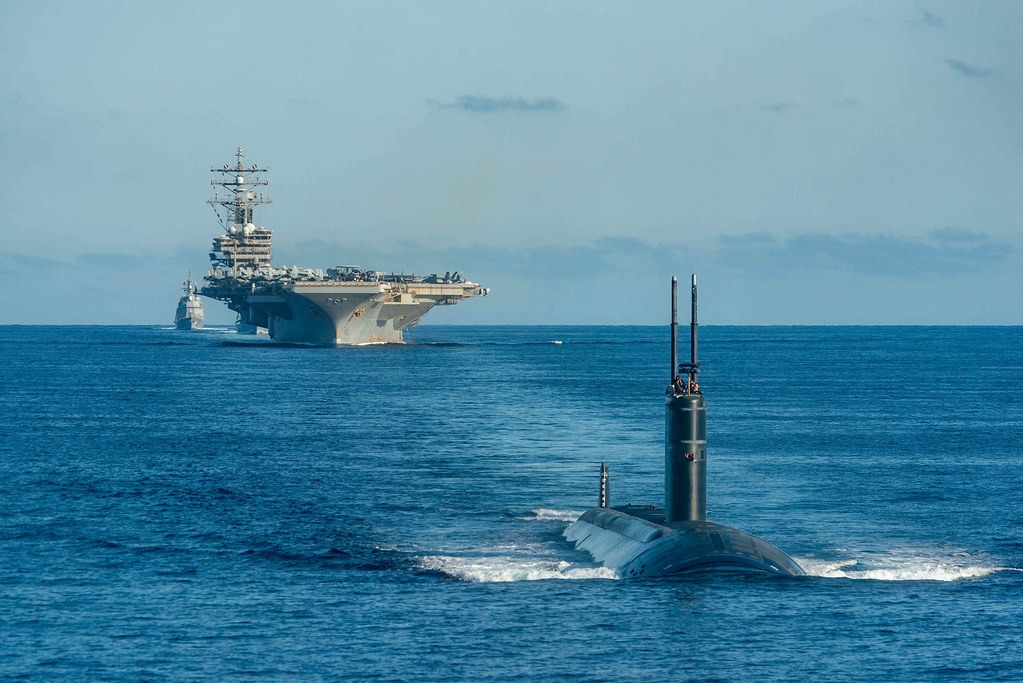
Image: A U.S. fast-attack submarine steams ahead of the aircraft carrier USS Ronald Reagan and ships with the Korean navy and Japan Maritime Self-Defense Force during a tri-lateral anti-submarine warfare exercise off the coast of the Korean peninsula, Sept. 30, 2022. Navy Petty Officer 3rd Class Gray Gibson, U.S. Department of War.