
Chinese Perspectives on Arms Control and Strategic Stability in Emerging Technologies
On November 27, 2025, China released a White Paper titled “China’s Arms Control, Disarmament and Non-proliferation in the “New Era,” which for the first time dedicated a chapter to outlining its international security governance propositions in emerging fields such as outer space, cyberspace, and artificial intelligence.
Dr. Tianjiao Jiang, notes that this white paper signals China’s move toward a more proactive role in arms control. Beijing is increasingly concerned with “cross-domain entanglement,” where emerging technologies blur the lines between traditional and modern warfare, creating new national and international risks. By dedicating a formal policy chapter to these emerging fields in the White Paper, Beijing is asserting its intent to be a primary architect of the 21st-century global security architecture.
The author highlights three primary “entanglements” threatening global stability:
-
Space Entanglement: China opposes the weaponization of space and the rise of mega-constellations like Starlink. These systems blur civilian-military lines, threaten digital sovereignty, and create power imbalances. Their potential for “non-kinetic” attacks (lasers, jamming) and high collision risks increase the likelihood of strategic miscalculation.
-
Cyber Entanglement: The integration of satellite internet has merged space and cyberspace, complicating attribution for attacks. This “cyber-nuclear” overlap poses a critical risk, as cyberattacks on satellite ground stations could compromise nuclear command and control (C3) systems, leading to unintended escalation.
-
AI and Strategic Entanglement: AI further complicates space, cyber, and nuclear security by overwhelming traditional defences and accelerating crisis timelines. A nuclear crisis triggered by AI could be an extremely pressing and catastrophic security risk.
The report suggests that Chinese and American experts should work together to send a message to both Beijing and Washington that the AI-nuclear issue needs to be a priority in bilateral relations, and that multi-layered safeguards against AI-induced crises are sorely needed. To that end, the author makes the following recommendations:
- The leaders of China and the United States should reaffirm the principle of keeping nuclear weapons under human control.
- Washington and Beijing should explore commitments on refraining from attacking each other’s AI systems within NC3.
- Both sides should explore banning unmanned platforms from carrying nuclear weapons.
- Establish a crisis management mechanism for emergencies involving unmanned equipment and space assets, and clarify protocols for handling such situations.
- Dialogue regarding strategic stability and nuclear posture remains indispensable.
- In addition to keeping humans in the loop, insurance mechanisms like nuclear fail-safe are still key.
- China and the United States should also jointly engage in dialogue and exchanges with other nuclear-weapon states, providing training and technical support in order to prevent an AI-nuclear crisis.
- Both sides should cooperate on pop culture featuring the AI-nuclear nexus to raise global awareness of the need for joint risk management.
To move beyond current limitations, the author further recommends broadening the engagement agenda to address three critical gaps in global strategic stability:
-
Technical Knowledge Gaps: There is insufficient unclassified analysis on how AI specifically “entangles” space, cyber, and nuclear systems. More research is needed on actual military AI applications to define what “meaningful human control” looks like in practice.
-
Role of Non-State Actors: Deep analysis is required to understand how private technology companies and commercial satellite constellations (like Starlink) shift the balance of power. This includes investigating how private-sector cyber vulnerabilities can propagate to nuclear facilities and developing domestic/international laws to regulate these actors.
-
Inclusion of the Global South: Official and informal (Track-II) dialogues must integrate Global South perspectives. This involves examining how major-power tech competition affects the security of developing nations and finding ways to bridge the digital divide without increasing technological security risks.
ABOUT THE AUTHOR
Dr. Tianjiao Jiang is Associate Professor at Development Institute of Fudan University. He also serves as deputy director of Center for BRICS Studies and research fellow of Center for Global AI Innovative Governance at Fudan. His research focuses on emerging technologies, international security and BRICS cooperation. He has published 4 books and more than 40 academic papers in the Journal of Chinese Political Science, Asian Perspective, Chinese Political Science Review, Copenhagen Journal of Asian Studies, etc. Dr. Jiang is member of China Arms Control and Disarmament Association, ACONA fellow of Davis Center for Russian and Eurasian Studies at Harvard University (2021-2022), and visiting scholar at Paul Tsai China Center of Yale Law School (2026). He is frequently interviewed by media outlets such as The New York Times, the South China Morning Post, and Le Monde, and has participated as an expert in P5 Young Professional Network and several Track II dialogues on Sino-US strategic stability.
The opinions articulated above represent the views of the authors and do not necessarily reflect the position of the Asia-Pacific Leadership Network or any of its members. The APLN website is a source of authoritative research and analysis and serves as a platform for debate and discussion among our senior network members, experts and practitioners, as well as the next generation of policymakers, analysts and advocates. Comments and responses can be emailed to apln@apln.network.
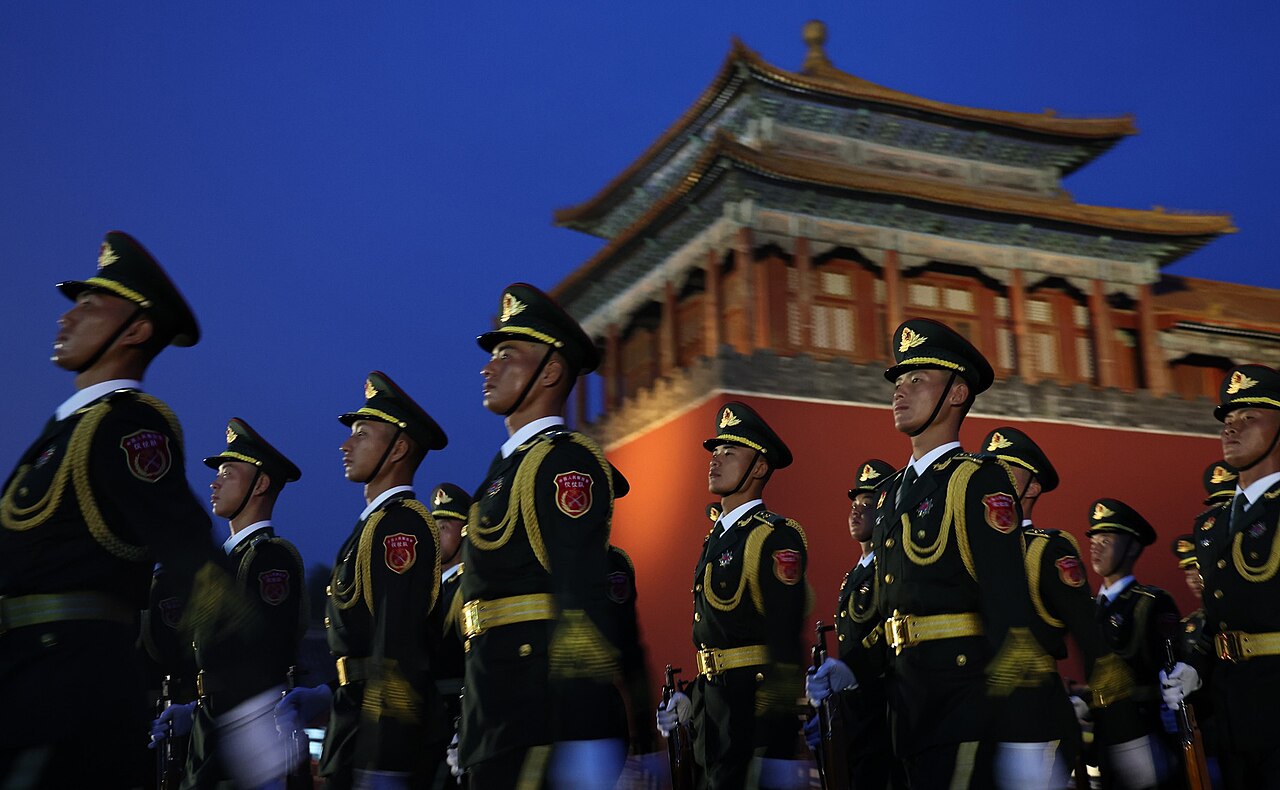
Image: People’s Liberation Army personnel before the 2025 China Victory Day Parade in Beijing. Wikimedia Commons.