The Case for a New Trump-Kim Summit
Dangers of the Nuclear Status Quo
“How do you solve a problem like Korea? You don’t, you just manage it.” Tim Marshall opened the chapter on Korea in his bestseller, Prisoners of Geography (2016), with this straightforward assessment. Throughout the post-Cold War era, however, South Korea and the United States tried to “solve” the problems of the Korean Peninsula either through dialogue and cooperation or through sanctions and pressure. Yet the durability of Northeast Asian geopolitics and the division of the peninsula made any “complete resolution” unrealistic. By focusing only on complete resolution, Seoul and Washington missed opportunities for effective management, including in denuclearisation diplomacy.
There is little disagreement that complete, verifiable, and irreversible denuclearisation (CVID) remains the most desirable goal. But this goal must be distinguished from what is realistically achievable. For over three decades, South Korea and the United States have used both incentives and coercive measures, yet failed to prevent North Korea from giving up its nuclear-weapons programme. After its sixth nuclear test and an ICBM test in 2017, Pyongyang declared the “completion of the state nuclear force” and effectively became one of the world’s nine nuclear-armed states.
The uncomfortable truths today are that North Korea now possesses a substantial nuclear arsenal and that complete denuclearisation has become nearly impossible for the foreseeable future. But abandoning denuclearisation diplomacy and allowing the current situation to drift unchecked is hardly a viable option. We have to remember that the nuclear status quo is not a nuclear freeze. President Donald Trump has said that North Korea possesses “57 very powerful nuclear weapons,” while President Lee Jae Myung warned in January 2026 that Pyongyang is producing enough fissile material for “10 to 20 nuclear weapons every year.”
The cost of denuclearisation is always lower today than tomorrow. That is the conclusion I have reached after observing the issue for decades. During the Agreed Framework and the Six-Party Talks, North Korea’s nuclear capabilities were still quite limited, leaving opportunities to contain the problem. Whenever diplomacy stalled, however, Pyongyang accelerated its nuclear development. To borrow a Korean saying, what could once have been stopped with a hoe is now difficult to stop even with a shovel.
Of particular concern is that North Korea may continue expanding its arsenal until it acquires a credible second-strike capability. Greater confidence in its nuclear deterrent could make Pyongyang more willing to engage in nuclear coercion or limited military actions. If North Korea’s nuclear status becomes entrenched, the international community may increasingly treat it as a fait accompli, weakening the NPT-centered nonproliferation regime and strengthening calls for nuclear weapons in South Korea and Japan. Doing nothing is, therefore, hardly a sustainable option.
South Korea’s Priority: Nuclear Suspension for Crisis Management
Reflecting this uncomfortable new reality, the Lee Jae Myung administration has proposed a phased denuclearisation strategy of “suspension-reduction-elimination.” The objective is not to abandon complete denuclearisation, but to change the sequencing and immediate policy priorities. The previous all-or-nothing approach centered on CVID and a “big deal” did not prevent North Korea from becoming nuclear-armed. Although much time has already been lost, the immediate second-best option is to prevent further deterioration through nuclear suspension.
The first stage could include suspending the production of weapons-grade fissile material, nuclear weapons production, nuclear and ICBM tests. Nuclear military exercises and nuclear threats against South Korea should also be addressed. North Korea is unlikely to accept such measures without compensation. Seoul and Washington should therefore prepare for a phased exchange in which nuclear suspension measures are matched by corresponding political, diplomatic, security, and economic measures.
Some experts argue that nuclear declaration and verification should be an integral part of nuclear suspension. Past experience, however, suggests caution, considering North Korea’s extraordinary resistance to demands for nuclear transparency. In fact, the breakdowns of the US-North Korea Agreed Framework and the Six-Party Talks agreements were partly attributable to disputes over verification. At the initial suspension stage, priority should be given to securing an actual halt in nuclear activities, accompanied by non-intrusive monitoring, while broader declaration and verification measures could be deferred to a later stage.
This is a realist policy aimed at results, not an appeasement policy based on wishful thinking. As long as North Korea retains nuclear weapons, South Korea must maintain strong self-defence capabilities and US extended deterrence. Sanctions can be eased in proportion to progress of nuclear suspension and reduction, but they should not be fully lifted while North Korea continues to possess nuclear weapons.
The Lee administration’s pragmatic diplomacy supports this approach. Its “E.N.D. initiative” calls for engagement, normalisation, and denuclearisation to proceed flexibly rather than in a rigid sequence. In practice, however, meaningful progress on the two other tracks – engagement and normalisation – will be possible only once a nuclear suspension is in place. This is why the Lee administration strongly hopes for a US-North Korea summit. At the August 2025 US-ROK summit, Lee asked Trump to act as a “peacemaker” while describing himself as a supporting “pacemaker,” recognising that the United States must play a leading role in restarting denuclearisation and a peace process on the Korean Peninsula.
Chances of a Trump–Kim Summit
One of the key questions here is how to bring North Korea back to the negotiating table. In the past, Pyongyang had strong incentives to seek security guarantees, sanctions relief, and economic assistance from Washington. Today, however, it has a substantial nuclear arsenal and has expanded security and economic cooperation with Russia and China. Its need for US engagement has declined, while Kim Jong Un’s memory of the failed Hanoi summit in 2019 gives another reason for caution.
Yet there are some notable recent developments for renewed summit diplomacy. Trump has repeatedly emphasised his good relationship with Kim and has recently avoided mentioning North Korean denuclearisation in his public messages. In mid-August, he described US-ROK military exercises as “totally inappropriate and hostile” and ordered them to be sharply scaled down. This can be read as an effort to improve the atmosphere for talks while taking into account Pyongyang’s longstanding demand for an end to what it calls Washington’s “hostile policy.”
Kim has also indicated that dialogue is possible if Washington does not make denuclearisation a precondition. Kim Jong Un’s sister, Kim Yo Jong, while sharply criticising both Seoul and Washington, has emphasised that Kim Jong Un retains fond memories of and positive feelings toward Trump. North Korea still has reasons to engage. A summit could offer opportunities for sanctions relief, normalisation of relations, greater access to the international economy, and improved international standing.
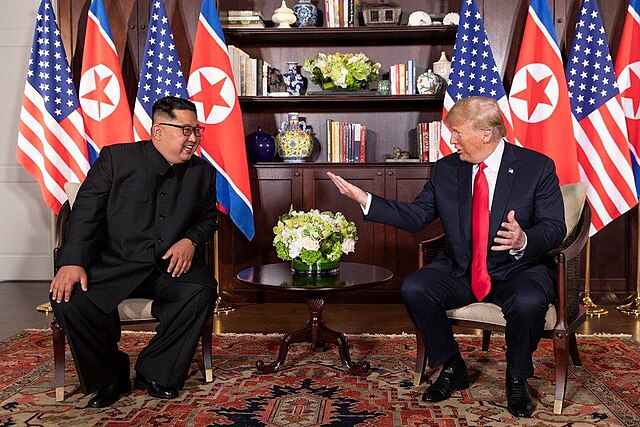
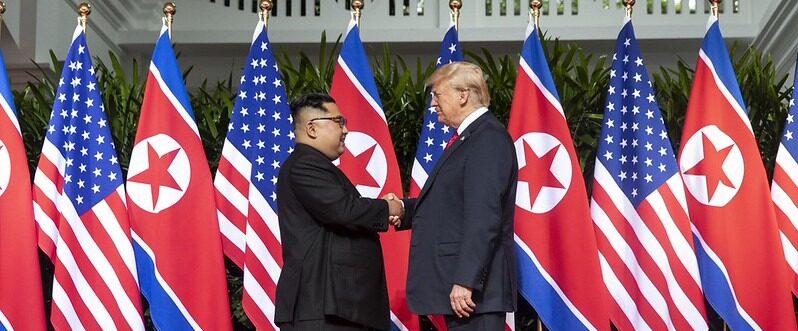
If a summit is held, the most important starting point would be to reaffirm the three core principles of their 2018 Singapore Joint Statement: new US-North Korea relations, a peace regime on the Korean Peninsula, and complete denuclearisation of the Korean Peninsula. Reaffirming these three goals would give both sides greater flexibility in negotiating concrete implementation measures, with an initial focus on nuclear suspension and corresponding measures, while helping pave the way for peaceful coexistance between the two Koreas.
To induce North Korea to attend a summit and take initial nuclear suspension measures, Seoul and Washington should prepare a political, diplomatic, security, and economic package in advance. Such an offer could change Kim’s calculus. The key is to convince Pyongyang that talking is more advantageous than not talking.
A Trump-Kim summit would carry risks, as frequently noted by the media and experts: sidelining Seoul, tacitly accepting North Korea’s nuclear arsenal and nuclear status, or producing a premature “small deal.” But the risks of allowing North Korea’s nuclear buildup to continue unchecked are far greater, as outlined above. If this opportunity is missed, the cost of denuclearisation will rise further and, over time, the opportunity for complete denuclearisation itself may disappear.
About the Author
Dr. Bong-Geun Jun is a Visiting Fellow at the Sejong Institute and President of the Korean Nuclear Policy Society. He also serves as an Advisor at the Center for Nonproliferation Studies at the Korea National Diplomatic Academy (KNDA), where he served as a professor for 18 years before his retirement.
Disclaimer: The opinions articulated above represent the views of the author(s) and do not necessarily reflect the position of the Asia Pacific Leadership Network or any of its members. The APLN’s website is a source of authoritative research and analysis and serves as a platform for debate and discussion among our senior network members, experts and practitioners, as well as the next generation of policymakers, analysts and advocates. Comments and responses can be emailed to apln@apln.network.
Image Credit: Shealah Craighead [Public domain], via Wikimedia Commons)