US Policy towards Southeast Asia under the Trump Administration
EXECUTIVE SUMMARY
In late Spring 2026, it is not a question if confidence in U.S. commitments to East Asia has diminished – but rather whether any shreds of the past idea of a security guarantee remain. As described in this report, the statements, policies and actions of President Donald Trump and his administration have shaken countries across the Indo-Pacific to their core and cast into doubt foundational assumptions about how the region’s security architecture works. As a range of East Asian-focused surveys and reports demonstrate, both the United States’ standing in the region and the perceptions of its power have dropped.
Other dynamics beyond the Trump administration including what Chinese officials regularly refer to as “the rise of China” and an evolving US-China relationship further contribute to this sense of seismic transition. Thus, the dominant question as 2026 nears its mid-point is: what will East Asian countries do about these changing dynamics? Within what timeframe will signs of a new (or renewed) architecture emerge? Using East Asia as the frame allows consideration of the People’s Republic of China both as a driver of change and as an actor within the system. While dynamics within the broader Indo-Pacific are treated at a strategic level, the primary focus of this analysis is likely actions of the countries of Southeast Asia, individually and as constituents, within the Association of Southeast Asian Nations (ASEAN).
The key question is framed as what will countries of Southeast Asia do about a perceived diminishment of a US security guarantee which regional leaders previously described as vital? Will their actions signal convergence towards a new regional strategy? Will the energy crisis besetting the region foster cooperation – as called for during the May 2026 ASEAN leaders’ meeting, or does the ‘every-country-for-itself’ approach seen during the 2025 tariff negotiations portend a weaker and more fractured region?
Contemplating the future, another key variable shaping Southeast Asian countries’ decision-making is identified. Over the next decade, the state of US-China relations will both drive and constrain Southeast Asian countries’ choice. Much has been written about how Southeast Asia serves as a primary site for contestation between the United States and China. Yet, at the other end of an imagined spectrum, if, over the next ten years, the United States and China develop a grand bargain on a set of rules and separate spheres of influence (described in the paper as a “G2 concert” akin to that reached by European states in the 1800s), the agency of Southeast Asian states could be impacted profoundly. Following President Trump’s May 2026 visit to China, discussion of such a concert has increased. In the paper, four theoretical scenarios are developed envisioning varying behavior by Southeast Asian nations in contexts featuring either concert or contestation between the United State and China. To emphasize the fact that these scenarios are abstract “ideal types” and to aid understanding of complex dynamics, each framework is associated with a classic East Asian film.
While the author agrees with analysts who see the most desirable conditions for the United States and China as some sort of “managed” competition, through the scenarios and case studies, this report focuses on the question: what are the most desirable conditions for the countries of Southeast Asia?
According to academics and officials with whom this author spoke during the preparation of this report – including during an excellent late-April conference in Malaysia, organized by the Asia-Pacific Leadership Network – as well as survey data on perceptions, for the countries of Southeast Asia, conditions are optimized when they maintain space for individual and collective maneuver in the political, security and economic space; they’re able to hedge to insulate themselves from vulnerabilities; and when the norms of a rules-based order, including around sovereignty and free trade, are preserved. Even though countries of Southeast Asia differ substantially, including in governance structures, economic conditions and sense of priorities and vulnerabilities, these conditions are best attained when countries of Southeast Asia converge, including through regional mechanisms.This report, thus, concludes with recommendations on how to steer towards that outcome while maintaining sufficient attention to the additional variables: the state of US-China relations and the aforementioned substantial differences. The recommendations focus on both internal and external steps that Southeast Asian nations can take, including through ASEAN and other Asian minilateral mechanisms. Although ambitious, the recommendations also look at limits to what ASEAN members collectively have been able to achieve – including during the first half of 2026 in responding to the aforementioned energy crisis.
Recommendations for Southeast Asian States:
- Strengthen ASEAN internally by actively and intentionally prioritizing actions and programs that align with the region’s most important goals in the economic pillar. ASEAN member states should continue to build their region into one of the fastest growing and dynamic economic areas in the world. For the countries of Southeast Asia, building individual domestic economies provides less resilience and is less impactful than building an ASEAN economy. ASEAN member states should lean into actions that further strengthen connectivity across the region, support energy needs, remove non-tariff barriers, facilitate trade and the movement of people, and continue to grow and unite an ASEAN Economy.
Aligned with this recommendation:
-
- Responding to pressing needs across the region following the US war with Iran, Southeast Asian nations should strengthen coordination and pursue practical, collective measures towards ensuring a stable energy supply at the regional level.
- Where they can, Southeast Asian nations should resist pressures to negotiate trade regimes bilaterally and look to address structural impediments to coordinating trade positions.
- As a focused and forward-looking ASEAN agenda is shaped, Southeast Asian leaders should highlight how these activities produce gains for, and investments in, the people of Southeast Asian nations. They can frame coordinated effort as helpful in tackling geopolitical & geoeconomic challenges emerging from outside the region.
- To effectively advance economically, ASEAN states need to get their house(s) in order individually and collectively. This includes resolving long-standing internal disputes over competing borders, ending the Thai-Cambodia conflict, and navigating a best-possible outcome on Myanmar. In the diplomatic sphere, the countries of Southeast Asia need both to support and ask more of each other.
- Strengthen ASEAN externally by continuing work to diversify economic partnerships, including with Canada, the European Union, and the Global South. Diplomatically, the countries of ASEAN should seek to make themselves an indispensable player in regional and global discussions, including about how middle powers can support the trade and legal regimes which have underpinned Southeast Asian countries’ growth.
- Simultaneously, Southeast Asian states should continue actively engaging both China and the United States. As they do this, leaders should recognize that while the US and China may feel threatened by Southeast Asian cooperation, leaders can make the case that “choosing ASEAN” is (still) choosing the less bad option.
Aligned with this recommendation:
-
- ASEAN countries should not rush to agree to a Code of Conduct (COC) on the South China Seas if the product undercuts international legal norms.
- Southeast Asian nations should not view President Donald Trump’s administration as temporary or an aberration but rather work to understand how structural developments in the United States have changed US priorities.
About the Author
Ambassador (retired) Piper Campbell is inaugural Chair of the Department of Foreign Policy and Global Security at American University’s School of International Service. She teaches courses on the Indo-Pacific and global diplomatic challenges and is Chair of the ASEAN and IndoPacific Studies Initiative. Having served as Head of the U.S. Mission to ASEAN (2018), Ambassador to Mongolia (2012-2015) and Consul General Basrah/Iraq (2011-2012), her areas of expertise include navigating U.S.-China competition and managing national security challenges. After a thirty-year diplomatic career, Ambassador Campbell left government in April 2019.
This report is published as a part of APLN’s Asia Dialogue on China-US Relations, supported by a grant from Andrew Carnegie Foundation, formerly known as Carnegie Corporation of New York. The views represented herein are the authors’ own and do not necessarily reflect the views of affiliated institution(s), nor that of APLN, its staff, members, board, or funders. APLN’s website is a source of authoritative research and analysis and serves as a platform for debate and discussion among our senior network members, experts, and practitioners, as well as the next generation of policymakers, analysts, and advocates. Comments and responses can be emailed to apln@apln.network.
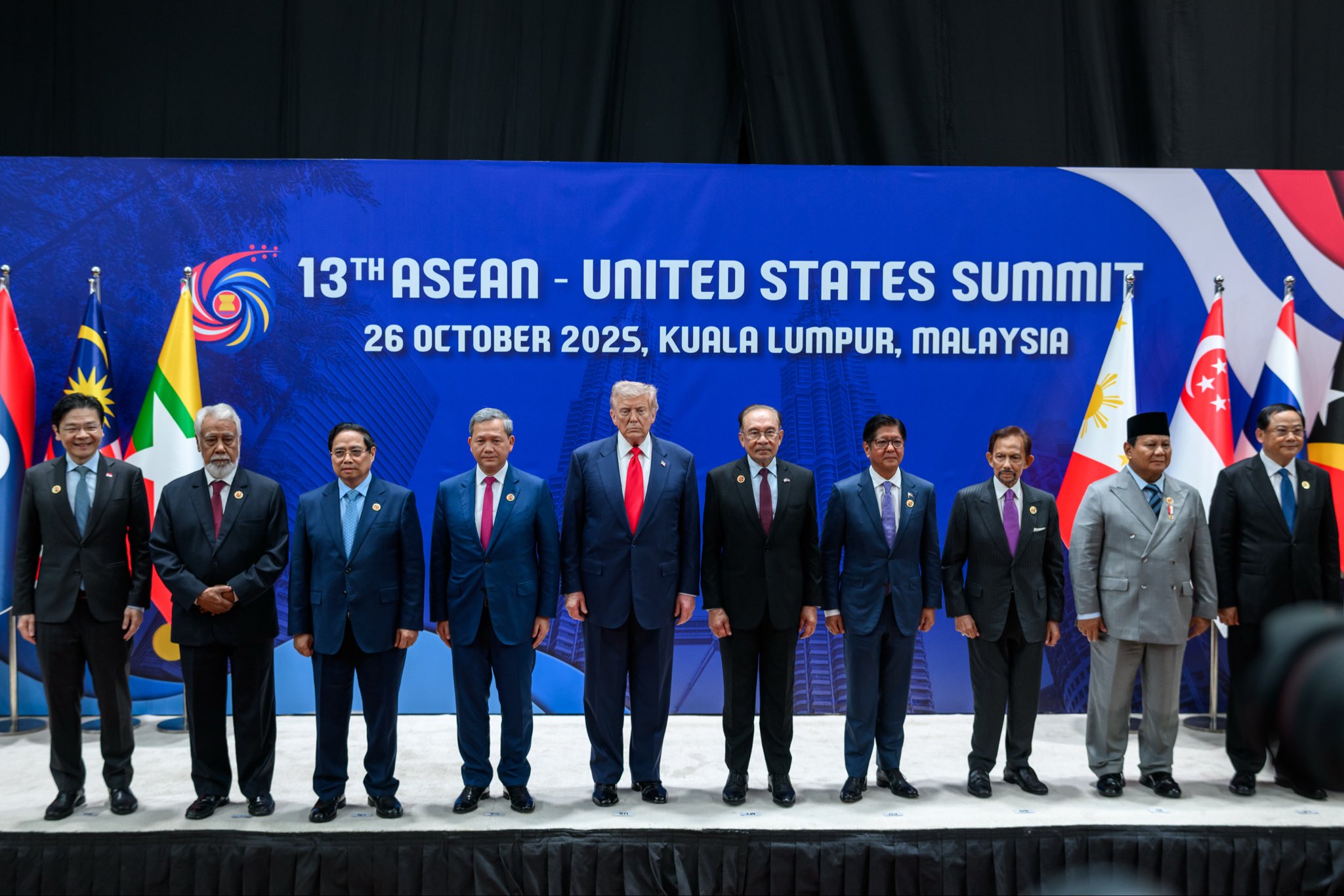
Cover image:13th annual U.S.-ASEAN Summit leader photo, Kuala Lumpur, Malaysia, 26 October 2025. Courtesy: Posted by the White House on X/ Wikimedia Commons.