Situating Malaysia’s Defence Partnerships: Prospects for the Next Decade
EXECUTIVE SUMMARY
Malaysia occupies a vital geostrategic position, straddling the Malacca Straits and the South China Sea. While its pragmatic diplomatic traditions have historically allowed it to maintain a delicate equilibrium, the deepening competition between the United States and China is increasingly challenging Malaysia’s ability to safeguard its strategic autonomy. Utilising the Malaysian government’s Defence White Paper as a foundational policy document, the paper assesses the impact of the shifting power dynamics between the United States and China on Malaysia and on regional stability in Southeast Asia, identifies key security risks likely to shape the Malaysian strategic environment in the near future, and evaluates Malaysia’s five most consequential defence partnerships from strategic, operational, and political perspectives.
Malaysia’s security posture has evolved beyond a predominantly territorial orientation to encompass a broader spectrum of challenges, including maritime security, non-traditional and transnational threats, and capacity-building imperatives, reflecting the increasingly complex and interconnected security environment facing Malaysian policymakers. This strategic adaptation, in turn, has positioned Malaysia as an important partner for both regional neighbours and extra-regional powers, enabling it to leverage defence partnerships to enhance capabilities, calibrate alignment, and contribute to stability in the region. At the same time, Malaysia’s role within the Association of Southeast Asian Nations (ASEAN) remains central to its strategic outlook, as it continues to prioritise regionalism, consensus-building, and the preservation of Southeast Asia’s autonomy amid intensifying great-power competition. As both a contributor to and beneficiary of ASEAN-led security frameworks, Malaysia reinforces multilateral cooperation while relying on the organisation as a key platform for managing tensions and sustaining regional stability.
Against this backdrop, this report offers an analysis of Malaysia’s defence relationships within the Southeast Asian and the broader Indo-Pacific security orders. It begins with a section outlining the strategic background and evolving regional security context confronting Malaysia’s political leadership and security establishment. Next, the report summarises and discusses the major premises of the Defence White Paper, the most important security and defence policy document of the Malaysian government in recent years. The report then examines Malaysia’s assessment of the balance of power between the United States and China in the next decade. Building on this foundation, the report evaluates the key security risks and threats likely to shape Malaysia’s strategic environment in the near future. It then surveys Malaysia’s major defence partnerships and identifies and analyses the five most consequential partners for Malaysia in the next decade, from the strategic, operational, and political perspectives. The report concludes with a set of policy-oriented recommendations aimed at strengthening Malaysia’s security and autonomy while leveraging these defence partnerships.
About the Authors
Dr. Chiew-Ping Hoo Chiew-Ping Hoo is Senior Fellow of the East Asian International Relations Caucus, member of the Asia-Pacific Nuclear Advisory Panel at British American Security Information Council, Editorial Board member of the AUP IR and Politics Series, Amsterdam University Press, and Research Fellow at the Yokosuka Council on Asia-Pacific Studies. From 2019 to 2020, she was a member of the Defence White Paper team of the Malaysian Ministry of Defence. From 2021 to 2022, she served on the Consultative Council on Foreign Policy of the Malaysian Foreign Ministry. Dr. Hoo’s research focuses on Korean Peninsula security and the security-economics linkages between Northeast and Southeast Asia.
Dr. Chow-Bing Ngeow Dr. Ngeow Chow Bing is Associate Professor and Director of the Institute of China Studies at the University of Malaya, and a Non-resident Scholar at Carnegie China. He received his PhD in Public and International Affairs from Northeastern University. He is editor of Populism, Nationalism and South China Sea Dispute (Springer, 2022, with Nian Peng), Researching China in Southeast Asia (Routledge, 2019) and Southeast Asia and China: A Contest in Mutual Socialization (World Scientific, 2017, with Lowell Dittmer). He has published in various academic journals such as Cold War History, Ocean Development and International Law, China Report, The China Review, Journal of Contemporary China, Asian Politics and Policy, Contemporary Southeast Asia, East Asia: An International Quarterly, Issues and Studies, Problems of Post-Communism, and others. In addition, he has also published shorter pieces on media and policy-oriented online platforms such as ThinkChina, East Asia Forum, The Asia Dialogue, and others.
This essay is published as a part of APLN’s Asia Dialogue on China-US Relations, supported by a grant from Carnegie Corporation of New York. The views represented herein are the authors’ own and do not necessarily reflect the views of affiliated institution(s), nor that of APLN, its staff, members, board, or funders. APLN’s website is a source of authoritative research and analysis and serves as a platform for debate and discussion among our senior network members, experts, and practitioners, as well as the next generation of policymakers, analysts, and advocates. Comments and responses can be emailed to apln@apln.network.
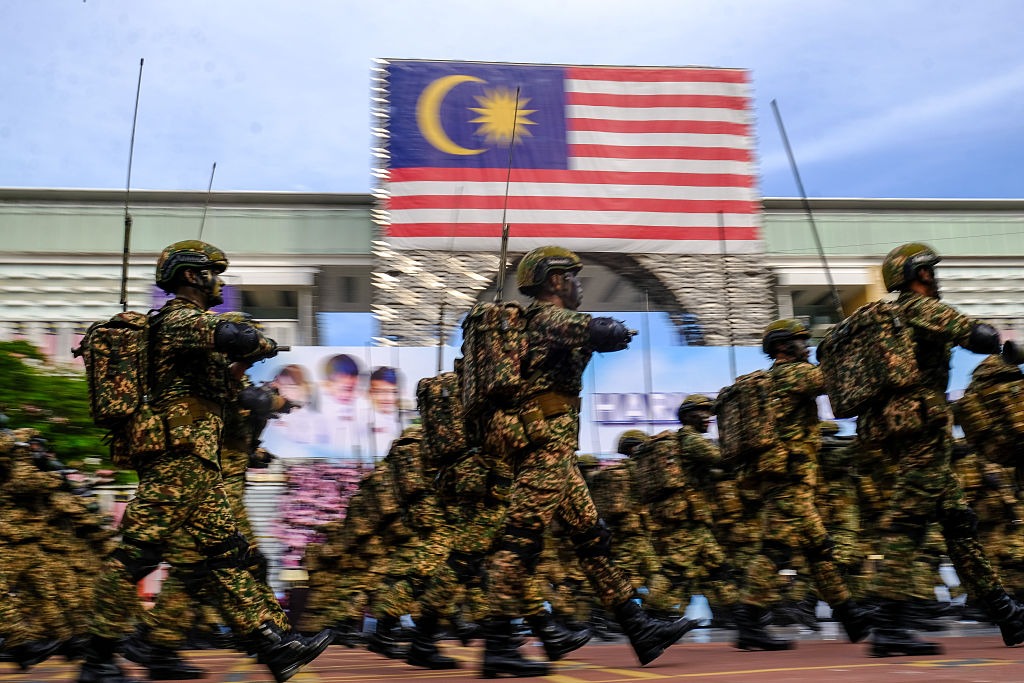
Cover image: Malaysia Army infantry soldiers uniformed contingents march. Courtesy: Getty Images