Non-Proliferation as a Strategic Imperative
The Republic of Korea is pursuing a set of nuclear policy initiatives: advancing efforts to modernize its nuclear fuel cycle and to introduce conventionally armed, nuclear-powered submarines. These initiatives reflect deliberate policy choices aimed at ensuring a stable supply of fuel for nuclear power generation, addressing spent fuel management challenges, and responding to a rapidly evolving security environment. Such efforts are undertaken fully within the bounds of the Nuclear Non-Proliferation Treaty (NPT), in a transparent manner and in full compliance with IAEA safeguards.
Yet, there are voices that raise questions as to whether these efforts might signal an intention by the Republic of Korea to pursue nuclear weapons or to develop latent nuclear capabilities. Such questions remain marginal but nonetheless warrant a clear and unequivocal response: Nothing could be further from the truth. At a time when the international community approaches another NPT Review Conference, it is both timely and necessary to reaffirm what non-proliferation truly means—and why, for the Republic of Korea, commitment to non-proliferation is not a legal constraint but a strategic choice.
Nuclear weapons alone cannot guarantee a nation’s security, nor can they ensure the well-being of its people. North Korea itself stands as the clearest proof of this fact. The peace and prosperity of the Republic of Korea rest on a broader foundation: security, economic strength and an open, democratic society—rather than on nuclear armament or on any illusion thereof.
From a security perspective, nuclear armament would introduce uncertainty, not strength. The Republic of Korea’s deterrence posture is based on a robust alliance framework, including combined defense capabilities and extended deterrence by the United States. Seeking nuclear armament would erode the credibility of extended deterrence and weaken one of the critical pillars of the alliance. It would also trigger a chain reaction of proliferation in the region, ultimately undermining the Republic of Korea’s security interests. At a time when achieving the denuclearization of North Korea remains an imminent challenge, it would be strategically unsound to invite a situation in which multiple actors possess nuclear weapons. Far from enhancing security, such a path would make the regional environment significantly more complex, unstable and unsafe.
Economically, nuclear armament would carry consequences that the Republic of Korea is uniquely ill-positioned to absorb. As one of the world’s most globally integrated economies, it depends on stable access to international markets, advanced technologies, and cooperative supply chains. Such a decision to pursue nuclear weapons would almost certainly trigger severe international sanctions, disrupt participation in the global nuclear supply chain, and prompt capital flight, driven by sanctions and weakened investor confidence. It would also place at risk the competitiveness of the Republic of Korea’s nuclear energy industry, which has been built on long-standing international trust in its non-proliferation commitments. In short, nuclear armament would undermine the very foundations of Korea’s long-term growth.
Beyond security and economics, such a course would fundamentally contradict the very character of modern Korean society. The Republic of Korea’s global standing reflects not only its economic and technological feats, but also its cultural vitality, openness and strong democratic values. Would a democratic society whose very existence is intrinsically bound up with the international community willingly choose a path that risks isolation, invites sustained sanctions, and forfeits the global prestige it has so carefully built? Moreover, could a society guided by democratic principles deliberately pursue a profoundly divisive course – one that imposes substantial societal costs? It is difficult to imagine such a choice.
For these reasons, the choice before us is not whether we will choose nuclear armament or risk vulnerability. Rather, it is whether we will undermine the foundations of our own strength or reinforce them. In this light, upholding the NPT is not simply a matter of principle, but a logical strategic imperative.
Modernizing the Republic of Korea’s nuclear fuel cycle will contribute to the resilience of the global nuclear supply chain and provide a pathway to address spent fuel management challenges. As a country with a proven record of upholding non-proliferation commitments while developing a globally competitive nuclear industry, the Republic of Korea stands as a trusted partner—one whose actions reinforce, rather than weaken, the non-proliferation regime.
The introduction of nuclear-powered submarines should also be understood in the same light. This initiative, which involves conventionally armed platforms powered by nuclear energy and is based on rock-solid US-ROK alliance, forms part of a broader effort to strengthen the Republic of Korea’s defense capabilities in response to the evolving security challenges posed by North Korea. It does not represent any move toward nuclear weapons or latent nuclear capabilities.
If the Republic of Korea were to abandon its commitments under the NPT, “that would mean becoming another North Korea.” I made that remark not long after taking office as Foreign Minister last year, when a question was raised as to whether there was public sentiment in Korea to consider the nuclear option. My answer was clear and unequivocal back then—and the reasoning behind it remains just as clear today.
About the Author
Dr. Cho Hyun is the Minister of Foreign Affairs of the Republic of Korea.
Cho was formerly Permanent Representative of the Republic of Korea to the United Nations, and also served as First Vice Minister (2018-2019) and Second Vice Minister (2017-2018) of Foreign Affairs. His previous posts include, among others, Ambassador to India (2015-2017), Ambassador to Austria and Permanent Representative to the International Organizations in Vienna (2011-2014), and Deputy Permanent Representative to the UN (2006-2008).
The opinions articulated above represent the views of the author and do not necessarily reflect the position of the Asia-Pacific Leadership Network or any of its members. APLN’s website is a source of authoritative research and analysis and serves as a platform for debate and discussion among our senior network members, experts, and practitioners, as well as the next generation of policymakers, analysts, and advocates. Comments and responses can be emailed to apln@apln.network.
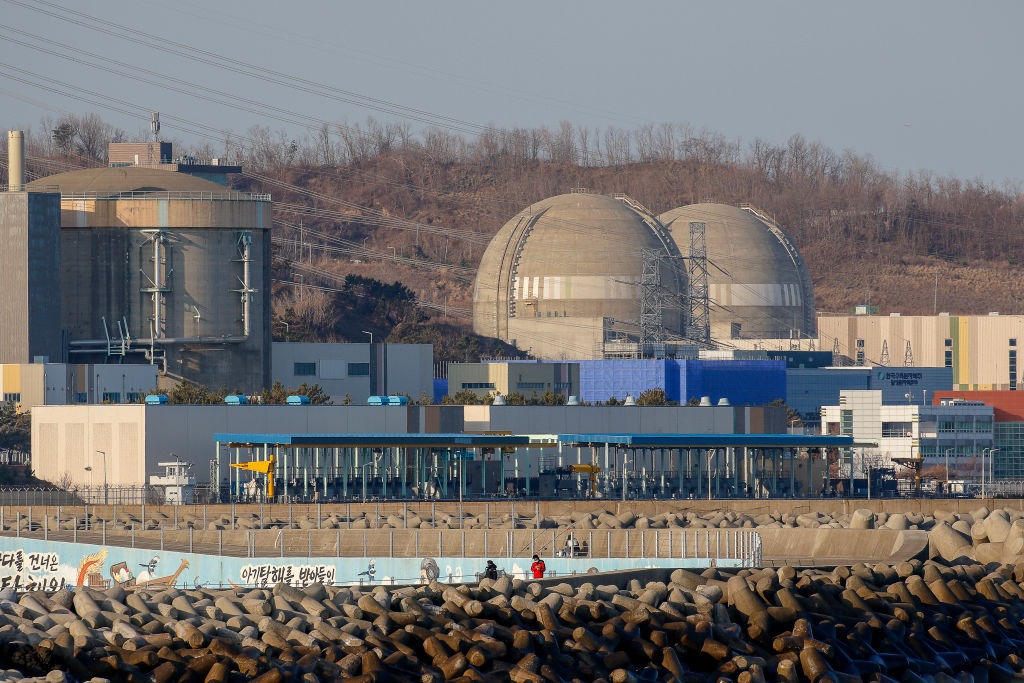
Image: A View of the South Korean first nuclear plant Wolsong 1 react and neclear plant at Wolsong-Myeong, South Korea. (Photo by Seung-il Ryu/NurPhoto via Getty Images)