Breaking the Korean Peninsula Nuclear Stalemate: Recommendations for the United States, South Korea, and China
Nuclear and strategic risks on the Korean Peninsula are steadily growing in the absence of coordinated diplomatic action to address them. The DPRK’s nuclear and strategic capabilities are expanding and diversifying as it exhibits growing self-confidence. This self-confidence partly draws from Russian strategic support and reduced dependence on China, complicating efforts to coordinate incentives and sanctions underpinning new DPRK talks and a framework agreement. The South Korean Lee administration has launched new diplomatic initiatives for the DPRK’s phased denuclearisation, but these have yet to receive serious consideration by the Trump administration and have been robustly rejected by Pyongyang.
Korean Peninsula nuclear concerns do not end at the 38th Parallel. The ROK Lee administration has recently underscored its commitment to the peaceful uses of nuclear energy, but at the same time is seeking to develop enrichment and reprocessing capabilities that could enable nuclear latency. Concrete legislative and other actions could allay some of these concerns, although uncertainties and tensions in the US-ROK relationship can fuel demand for nuclear weapons hedging options. Reports at the time of the workshop concerning apparent US planning to relocate air and missile defence assets from South Korea to the Middle East to support operations against Iran highlight the need for closer US-ROK alignment on the direction of their relationship, and pathway to engaging Pyongyang.1
On March 27, 2026, a group of US, ROK, and international senior Track-II former officials and experts were convened in Washington for a workshop co-hosted by the Asia-Pacific Leadership Network (APLN) and Carnegie Endowment for International Peace to consider these issues and suggest pathways forward to reduce nuclear risks on the Korean Peninsula. This policy brief summarises their findings and concludes with proposed recommendations for the United States, ROK, and China as key stakeholders in these security challenges.
This analysis and selected policy proposals have also informed a separate joint statement by by some of the workshop participants, offering recommendations ahead of the May 2026 Trump-Xi summit. The report includes specific policy recommendations for the United States, the Republic of Korea, and China.
POLICY RECOMMENDATIONS
Recommendations for the United States
- The US should place Korean Peninsula security on the agenda for the May 2026 Trump-Xi summit and subsequent high-level bilateral interactions. Trump should personally and consistently raise Korean Peninsula security as an issue whenever he talks with Xi, ensuring that the Chinese leadership understands this is a serious US priority.
- The Trump administration should internally determine its definition of stable co-existence as the basis for negotiations; the political, economic, and military incentives it is willing to provide; the costs it is willing to accept; the minimum DPRK concessions it will require for a negotiated agreement; and its working definitions of “nuclear risk reduction”, “stability”, and “provocations” prior to engaging the Lee administration on these points. This review should begin immediately.
- As part of a stable co-existence framework, Washington and Seoul should also discuss potentially proposing an end-of-war declaration to Pyongyang, including mitigation plans against its possible side-effect of undermining the rationale for US-ROK alliance commitments.
- US efforts to develop internal agreement and engage ROK on these points need to proceed expeditiously, given the rapidly expanding and diversifying nuclear and strategic threats that the DPRK pose.
- US-ROK alignment on key working definitions of terms; the desired outcome of DPRK talks; and the incentives they are willing to offer and costs they are willing to bear as part of achieving this outcome are critical to achieve before US-DPRK talks could begin.
- Establishing a high-level US-ROK taskforce can accelerate this process, while continuing to meet to consult on the progress of direct DPRK talks.
- The US should also appoint a Special Envoy to the DPRK, to both support this high-level US-ROK task force and US-DPRK talks once these commence.
- In direct talks with the DPRK, the US should seek common ground on working definitions of “stable co-existence”; “nuclear risk”; “nuclear risk reduction”, “stability”, and “provocations”. Washington should also probe Pyongyang’s willingness to reaffirm all or parts of the 2018 Singapore Statement, and explore other potential mutual compromises. The US should then work to reconcile these definitions and compromises with US-ROK understandings in close consultation with ROK leaders.
- As an early outcome of US-DPRK talks, Washington should seek to establish a small US Liaison Office with US Foreign Service Officers posted within the Swedish Embassy in Pyongyang (as the protecting power of US official interests in the country in the absence of a US-DPRK diplomatic relationship). This diplomatic channel would advance stable co-existence efforts.
- Recognising legitimate international concerns about the durability of US policy commitments across successive presidencies, US negotiators should insist that international institutions be empowered to monitor compliance by all parties with their commitments under any diplomatic agreement.
- The US should engage China, ROK and Japan – and Russia if ready to cooperate – on crisis management and cooperation mechanisms to be activated in case of a serious conflict instigated by the DPRK.
Recommendations for the ROK
- Reflecting the Lee administration’s notable willingness to embrace the formulation “nuclear-free Korean Peninsula”, it should be equally open to accepting that denuclearisation can be most feasibly attained in the long term through a more realistic focus on stable co-existence.
- Seoul should actively encourage Washington to expedite US deliberations on objectives and definitional terms underpinning a DPRK policy; begin bilateral US-ROK talks to attain alignment; and conduct DPRK direct talks following these US-ROK consultations.
- The Lee government should further clarify how its civil nuclear developments are safeguarded against being used toward nuclear weapons hedging, to allay US and regional concerns counterproductive to Northeast Asian nuclear risk reduction efforts. This could include legislation and other measures to bind successor ROK governments.
Recommendations for China
- China should acknowledge the seriousness of DPRK strategic and tactical challenges to regional stability, and engage in structured, working-level dialogues with the United States on how each defines Korean Peninsula stability, identifies major risks, and moves toward a common approach. This should include dedicated discussions on this point at the rescheduled May 2026 and subsequent US-China summits.
- Cooperation between China and the United States on Korean Peninsula security should be decoupled from their broader relationship.
- Beijing should support US-ROK efforts to agree an end-of-war declaration with DPRK, including treating a commemoration ceremony as an opportunity for high-level bilateral and multilateral diplomacy on Korean Peninsula security.
- Beijing should recognize that certain DPRK nuclear and strategic developments, such as potential space-based nuclear weapons, threaten core Chinese interests, and support US and global efforts to develop norms and constraints against development of these forces
About the Author
Dr. Frank O’Donnell is a Senior Research Adviser in the Asia-Pacific Leadership Network. His areas of expertise include nuclear and conventional military posturing, arms control, nonproliferation, and national security policymaking processes. He was previously Deputy Director and Fellow in the Stimson Center South Asia Program, and has held postdoctoral research roles at the Fletcher School and US Naval War College. He has been a Stanton Junior Faculty Fellow and Associate at the Belfer Center for Science and International Affairs at Harvard University, an Assistant Professor (UK: Lecturer) at the Britannia Royal Naval College, and has held additional research positions at the University of Aberdeen and James Martin Center for Nonproliferation Studies.
The opinions articulated above represent the views of the authors and do not necessarily reflect the position of the Asia-Pacific Leadership Network or any of its members. The APLN website is a source of authoritative research and analysis and serves as a platform for debate and discussion among our senior network members, experts and practitioners, as well as the next generation of policymakers, analysts and advocates. Comments and responses can be emailed to apln@apln.network.
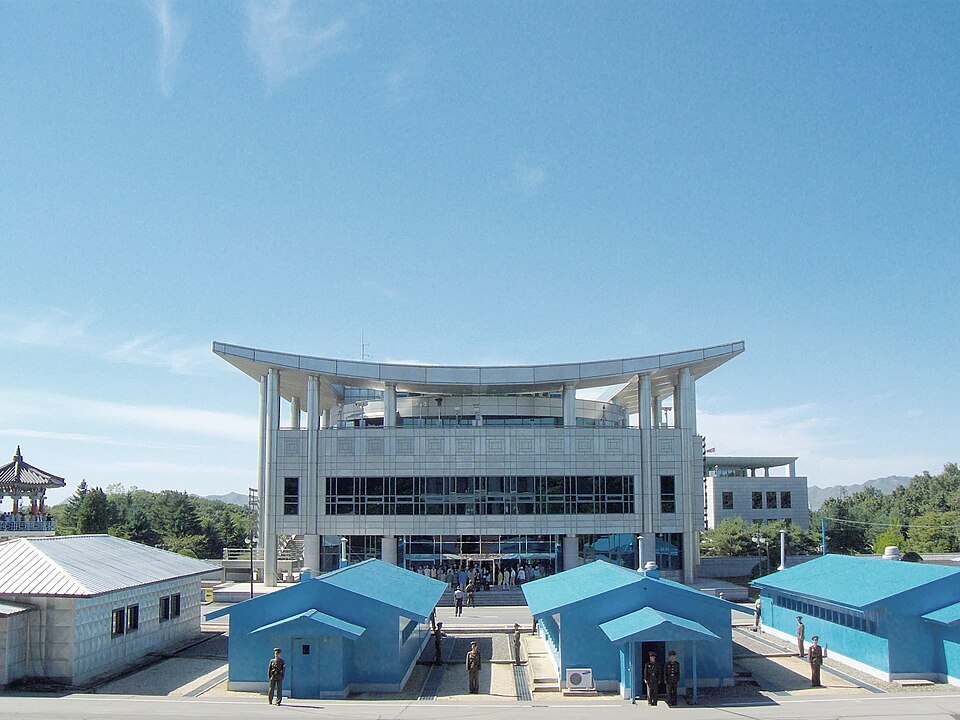
Image:Joint Security Area, Demilitarised Zone, Korea Wikimedia Commons.