State-to-state cooperation between NATO and IP4 member states: Successes, constraints, and prospects for crisis prevention
This report draws on discussions among an international working group convened by the European Leadership Network (ELN) and the Asia-Pacific Leadership Network (APLN). The following experts contributed to the development of the report and endorse it in their personal capacities: Professor Maria Rost Rublee (Chair), Mr. Kester Abbott, Brigadier (Ret.) Robbie Boyd, Mr. Joel Christoph, Dr. Connor Clery, Ms. Tsiporah Fried, Professor Bethan Greener, Mr. Chae Kyoun (CK) Ha, Ambassador Jane Hardy, Dr. Dongkeun Lee, Professor Stephen Nagy, Dr. Frank O’Donnell, Ambassador Robert Ondrejcsák, and Ms. Shatabhisha Shetty.
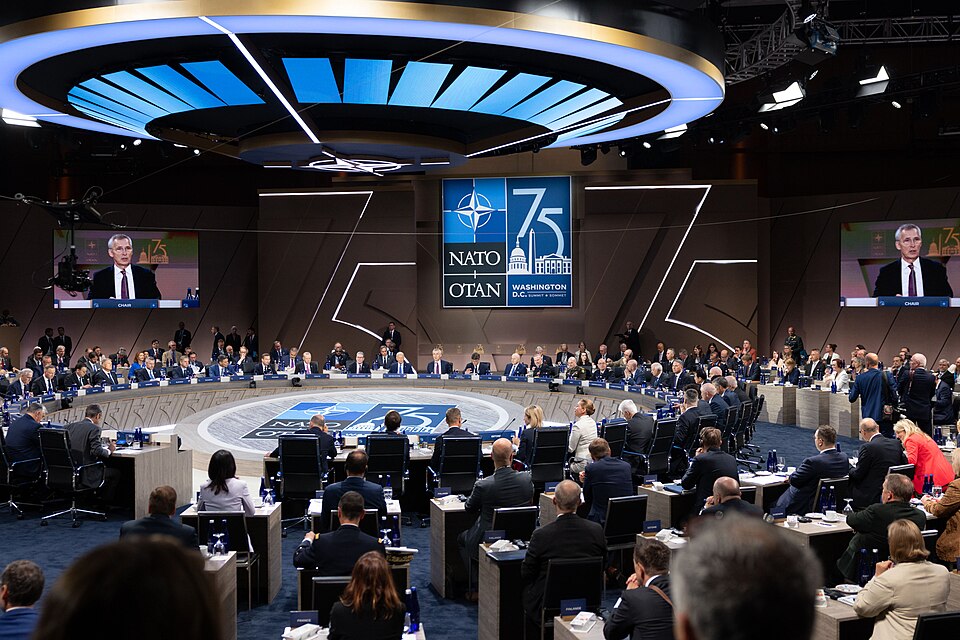
Security cooperation between NATO members and the Indo-Pacific 4 – Australia, Japan, New Zealand, and the Republic of Korea – is no longer confined to formal engagement between NATO and its partners. Bilateral and minilateral relationships are also expanding, including defence-industrial cooperation, maritime security initiatives, intelligence-sharing, and new political and military partnerships.
These arrangements offer practical opportunities to strengthen crisis prevention across the Euro-Atlantic and Indo-Pacific. But cooperation is constrained by diverging threat perceptions, uncertainty surrounding US strategy, limited resources, and differences in countries’ political willingness and capabilities.
Drawing on discussions among Track-II experts from both regions, this report examines how individual NATO and IP4 states can cooperate more effectively. It focuses on defence-industrial resilience, maritime security, emerging technologies, the Women, Peace and Security agenda, and working-level coordination.
Flexible state-to-state arrangements can strengthen preparedness and resilience, even where formal institutional cooperation remains difficult. Rather than relying solely on such formal mechanisms, NATO and IP4 states should deepen practical cooperation through bilateral and minilateral partnerships.
The report highlights opportunities to strengthen defence-industrial resilience, maritime security, intelligence-sharing, emerging technologies, and defence supply chains, while expanding working-level exchanges and building more resilient networks for crisis prevention across the Euro-Atlantic and Indo-Pacific. It concludes that adaptable, capability-driven partnerships are likely to deliver more tangible results than highly institutionalised arrangements. Detailed policy recommendations are available in the full report.
This report was produced by a working group convened by the European Leadership Network and the Asia-Pacific Leadership Network. It was sponsored by the NATO Science for Peace and Security Programme under grant SPS.MYP.G7935. The views expressed are those of the authors and do not necessarily reflect the position of NATO, the European Leadership Network, the Asia-Pacific Leadership Network, or the other institutions mentioned in the report. The ELN aims to encourage debates that will help develop Europe’s capacity to address the pressing foreign, defence, and security policy challenges of our time, in furtherance of its charitable purposes.