
Military Exercises and Security Multialignment in Asia amid US-China Competition
Military exercise proliferation has been intensifying in Asia amid growing strategic competition. The United States has tried to further solidify its leading position in this space with allies and partners amid new inroads by China. Meanwhile states in subregions like the Indian Ocean, Northeast Asia, and the Pacific Islands are struggling to manage alignment and resource constraints. They are also engaging with a more diversified group of partners extending out to regions such as Europe. The dynamics that military exercises produce are critical to Asia’s regional security. The exercise mix in the coming years will help shape norms and the balance of power in areas of importance across the region as a whole as well as in its core subregions.
This policy brief explores the ongoing military exercise proliferation in Asia’s security environment and the opportunities and challenges it creates. It is informed by conversations with exercise planners, policymakers and experts across key regional capitals, including multiple field research trips. The paper makes three main arguments. First, military exercise proliferation in Asia over the past few years is evident across four key metrics: countries, services, issue areas, and geographies. Second, this proliferation impacts the evolving dynamics in Asia’s security landscape across five components – capacity, inclusivity, value, efficiency, and transparency. Third, regional actors can take concrete steps to help shape the direction of this military exercise proliferation in ways that maximise the benefits and minimise the risks across the four areas of the acronym DIME – diplomatic, informational, military and economic.
About the Author
Dr. Prashanth Parameswaran is a senior fellow at the Institute for Indo-Pacific Security and founder of the weekly ASEAN Wonk newsletter on Southeast Asia and Indo-Pacific geopolitics and geoeconomics. Born and raised in Southeast Asia, he is also a senior columnist at The Diplomat, an advisor at the strategic consultancy BowerGroupAsia, a fellow at the Institute for Indo-Pacific Security, and an instructor for regional courses at the State Department and Pentagon. He has spent nearly two decades working with businesses, think tanks, governments, and universities in Southeast Asia and the Indo-Pacific region, including early stints with Singapore’s Ministry of Trade and Industry, the Agence France-Presse news wire service agency in Thailand, and the Center for Strategic and International Studies in Washington, DC. He has conducted extensive field research across the Indo-Pacific region, including all eleven countries in Southeast Asia, publishing over 2000 articles and commentaries in international outlets such as CNN, The Straits Times, Nikkei Asia, South China Morning Post, and Foreign Policy on topics including major power competition, maritime security, economic statecraft, regional institutional development, military modernization, and foreign policy strategy. He is the author of two books: Mandalas of Multialignment: Hedging Bets in Southeast Asia Grand Strategy Spheres, Foreign and Security Policy Webs, and Global Geopolitics and Geoeconomics (2026) and Elusive Balances: Shaping US-Southeast Asia Strategy (2022). He holds a PhD and an MA from the Fletcher School of Law and Diplomacy at Tufts University, and a BA with highest honors from the University of Virginia.
This essay is published as a part of APLN’s Asia Dialogue on China-US Relations, supported by a grant from Carnegie Corporation of New York. The views represented herein are the authors’ own and do not necessarily reflect the views of affiliated institution(s), nor that of APLN, its staff, members, board, or funders. APLN’s website is a source of authoritative research and analysis and serves as a platform for debate and discussion among our senior network members, experts, and practitioners, as well as the next generation of policymakers, analysts, and advocates. Comments and responses can be emailed to apln@apln.network.
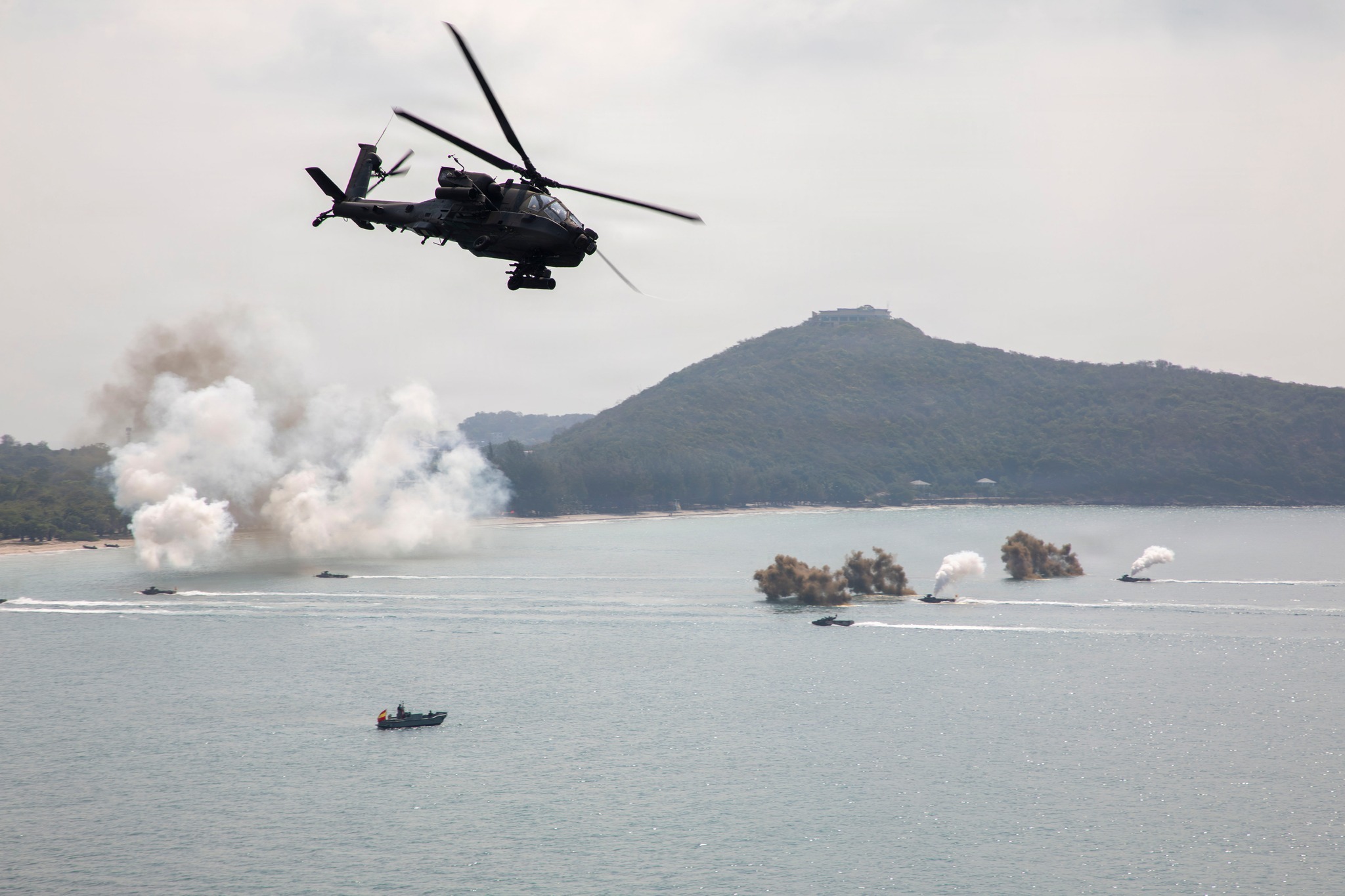
Cover image: US and Royal Thai Armed Forces executed a high-intensity counter-landing demonstration during Exercise Cobra Gold 2026 at Hat Yao Beach, Rayong province, Thailand, February 28, 2026. Source: FaceBook/Sgt. Briana Vera.