
China and AI-Military Integration: Perspectives, Opportunities, and Challenges
In this policy brief, Jingdong Yuan provides a timely assessment of China’s strategic pivot toward military “intelligentisation” (智能化), exploring how Beijing is integrating AI into the PLA to gain a decisive edge in its rivalry with the United States. Driven by mandates from the 20th National Congress of the CPC, the Chinese military is aggressively transitioning from information-guided and network-centric warfare to AI and automation-driven modernisation. Drawing insights from recent global conflicts where AI redefined battlefield speed, this paper examines how Chinese analysts view these disruptive technologies as a historic opportunity to rewrite modern military doctrine and “overtake on a curve” (弯道超车).
This policy brief provides a preliminary assessment of Chinese perspectives on AI and its military applications, with a focus on the AI-nuclear nexus. It begins by presenting Chinese debates and discussions regarding various aspects of AI and its applications in the military domain, including the benefits and risks of AI’s integration into the nuclear enterprise. This is followed by a brief review of Chinese interests and developments in the military applications of AI, from nuclear command, control and communication (NC3) to decision-making and autonomous nuclear weapons systems. The next segment explores some of the potential risks inherent in AI-nuclear integration and the challenges that the PLA faces in pursuing AI military integration. The paper concludes with a set of policy recommendations.
About the Author
Jingdong Yuan, PhD, is Associate Senior Fellow at Stockholm International Peace Research Institute (SIPRI). He was previously an Associate Professor at the Centre for International Security Studies, University of Sydney. Dr Yuan’s research focuses on Indo–Pacific security, Chinese foreign policy, Sino–Indian relations, China–European Union relations, and nuclear arms control and nonproliferation. He has held visiting appointments at the National University of Singapore, University of Macau, East–West Center, National Cheng-chi University, Mercator Institute for China Studies, Fudan University, Berlin Social Sciences Centre (WZB) and the United Nations Institute for Disarmament Research (UNIDIR). He is the co-author of Chinese cruise missiles: a quiet force-multiplier (2014) and China and India: cooperation or conflict? (2003), and co-editor of Engaging China: How Australia Can Lead the Way Again (2023), Trump’s America and international relations in the Indo–Pacific (2021), and Australia and China at 40 (2012). His publications have appeared in numerous journals and edited volumes, including “The United States and Stability in the Taiwan Strait,” “External and Domestic Drivers of Nuclear Trilemma in Southern Asia: China, India, and Pakistan,” among others.
The opinions articulated above represent the views of the authors and do not necessarily reflect the position of the Asia-Pacific Leadership Network or any of its members.
The APLN website is a source of authoritative research and analysis and serves as a platform for debate and discussion among our senior network members, experts and practitioners, as well as the next generation of policymakers, analysts and advocates. Comments and responses can be emailed to apln@apln.network.
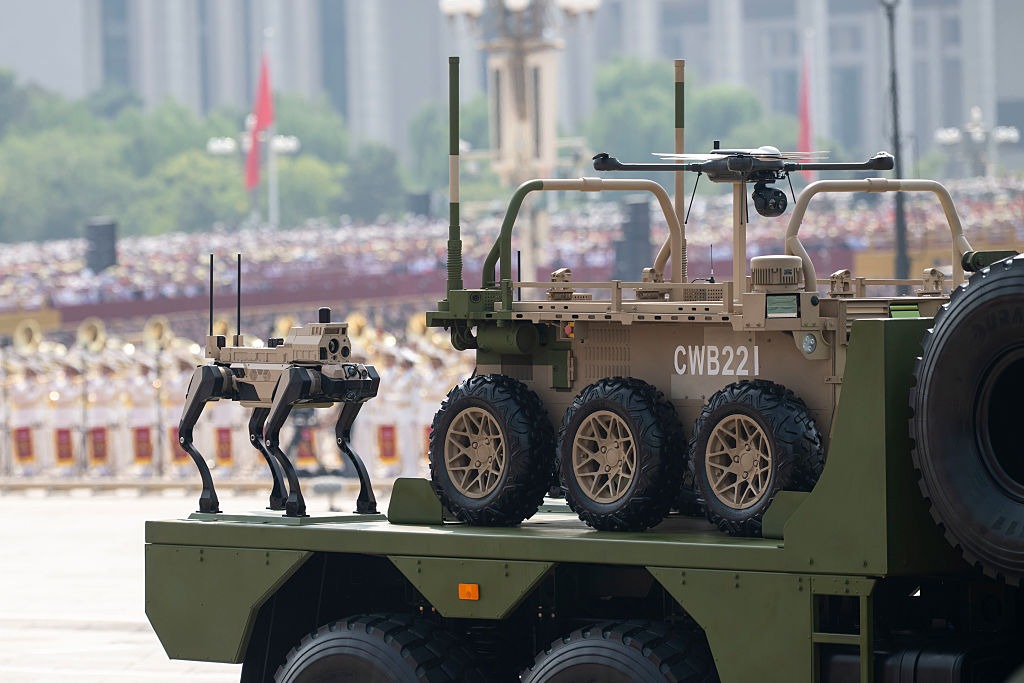
Image: Getty Images – China Unveils New Weapons In V-Day Parade