

APLN Membership Survey: Cyberattacks on NC3 is the greatest emerging threat
Executive Summary
Download the full survey (PDF)
Released ahead of the 2026 NPT Review Conference, the findings of the inaugural APLN Membership Survey offer a rare window into how the Asia-Pacific’s most senior nuclear policy practitioners assess the risks that will shape the conference agenda. With concerns over testing resumption, the collapse of arms control frameworks, and the vulnerability of nuclear command systems dominating responses, the survey captures a region of bracing for a pivotal moment in the non-proliferation regime.
Four principal findings emerge:
- First, cyber capabilities targeting nuclear command and control are viewed as the most dangerous emerging technology, with 91% of respondents rating their impact as negative or very negative, far exceeding concern about artificial intelligence in military decision-making (70%).
- Second, the resumption nuclear testing and the absence of arms control agreements dominate member concerns about the nuclear policy landscape, ahead of any single state’s weapons programme.
- Third, a sharp tension exists between members’ desire to strengthen existing regional mechanisms and their scepticism that those mechanisms can deliver meaningful risk reduction.
- Fourth, US-China strategic competition is experienced primarily as coercive pressure rather than as an impetus for productive alliance-building or diplomatic manoeuvres.
Finding 1: The NC3 Consensus
Cyber capabilities targeting nuclear command and control systems are the single highest-intensity concern among all emerging technologies assessed. 91% of respondents rated their impact as negative or very negative. Critically, 52% selected ‘very negative’, the highest rate of extreme concern for any technology in the survey. This far outpaces the concern registered for AI in military decision-making (70% net negative, 26% very negative) and autonomous weapons systems (74% net negative).
The gap between cyber-NC3 concern and AI concern is analytically significant. Public and policy discourse has been dominated by anxiety about artificial intelligence in warfare. Yet this cohort of senior practitioners and scholars, many of whom have direct experience with nuclear command architecture, identifies the vulnerability of existing command and control systems to cyber intrusion as the more immediate and destabilising risk. The distinction matters: AI introduces new decision-making capabilities, whereas cyber threats to NC3 undermine the integrity of systems already in place, raising the spectre of misattribution, false alerts, or loss of assured second-strike capability.
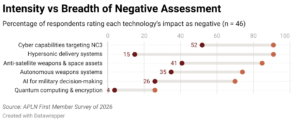
Figure 1: Breadth versus intensity of negative assessment for selected emerging technologies (n = 46). Right dots indicate total negative responses; left dots indicate ‘very negative’ responses only. Cyber capabilities targeting NC3 and hypersonic delivery share the highest total concern (91%), but NC3 registers far greater intensity (52% vs 15% ‘very negative’).
The quantum computing result deserves a separate note. Half of respondents (50%) selected ‘don’t know / no particular impact’, the highest uncertainty rate in the survey by a wide margin. This does not reflect indifference. It reflects candid acknowledgement from a highly informed group that the security implications of quantum capabilities remain genuinely unclear. For APLN’s emerging technology research agenda, this points to a space where targeted analysis could be particularly valuable.
Finding 2: The Arms Control Vacuum
When asked to rank seven nuclear weapons policy issues by level of concern, members placed the resumption of nuclear testing and the absence of bilateral or multilateral arms control agreements clearly at the top. Testing was ranked as the single most concerning issue by 37% of respondents and appeared in the top three for 74%. The absence of arms control agreements was ranked first by 24% and appeared in the top three for 63%. Between them, these two structural concerns account for 61% of all first-place selections.
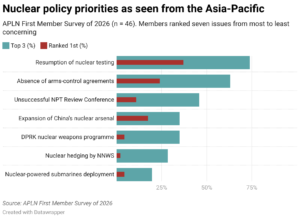
Figure 2. Nuclear weapons policy concerns ranked by APLN members (n = 46). Inner bars (red) show the share of respondents ranking each issue as their single most pressing concern; outer bars (teal) show the share ranking it in their top three.
Notably, the DPRK nuclear weapons programmes (35% top-three) and the expansion of China’s nuclear arsenal (35% top-three) ranked lower, despite generating the most media coverage. This suggests that APLN members are more concerned about the systemic erosion of the arms control and non-proliferation architecture than about the behaviour of any single actor. The prospect of an unsuccessful NPT Review Conference was ranked in the top three by 46% of respondents, placing it directly at the intersection of these two anxieties.
The 2026 NPT Review Conference opens later this month against a backdrop of allegations regarding the nuclear testing moratorium and the near-total absence of functioning bilateral arms control arrangements. These are precisely the two issues members ranked highest. The survey data suggest members view them as linked: a failed Review Conference would not just be a diplomatic setback, but a confirmation that the institutional infrastructure for managing nuclear risk is coming apart.
Finding 3: The Architecture Paradox
Members were asked whether Asia-Pacific policymakers should prioritise strengthening existing risk-reduction mechanisms or developing new approaches. The result was a near-even split: 54% favoured new approaches, while 46% preferred strengthening existing ones. Neither camp holds a clear majority, which makes the division itself worth examining.
Among those who favoured existing mechanisms, open-text responses reveal a fragmented institutional landscape (Figure 3). The ASEAN Regional Forum was cited most frequently, followed by the East Asia Summit, but together they account for just over half of all citations. The remainder is scattered across the SCO, the Pacific Islands Forum, the NPT, and general calls for dialogue. No single mechanism commands consensus, even among those who believe the priority should be to work within existing architecture. This internal fragmentation is compounded by scepticism: one senior former diplomat who selected ‘develop new approaches’ described the ARF as ‘likely to remain ineffective’, while acknowledging that new approaches face equally difficult prospects.
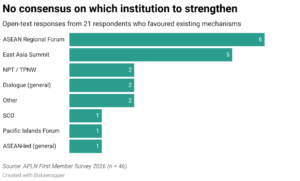
Figure 3. Institutional mechanisms cited for strengthening by APLN members who favoured existing risk-reduction frameworks (n = 21). Open-text responses, categorised by institution. The ASEAN Regional Forum and East Asia Summit lead, but no mechanism captures a majority of citations, suggesting that even the ‘strengthen existing’ camp lacks a shared institutional anchor.
Respondents who favoured new approaches pointed to frameworks that do not yet exist: a Northeast Asia security mechanism, a coalition of middle powers and nuclear-weapon-free-zone states, the revitalisation of the South Pacific Nuclear Free Zone Treaty, and the re-establishment of Six Party Talks. The thread running through these proposals is that existing regional architecture was not built for the current level of nuclear risk in the Asia-Pacific.
Finding 4: The Alignment Squeeze
The impact of US-China strategic competition on members’ national defence and foreign policy environments was assessed through a multi-select question allowing up to three responses. The dominant experience is one of coercive pressure: 63% cited increased pressure to align with one side, while 59% pointed to accelerated defence modernisation programmes. Reduced space for diplomatic engagement was noted by 37% and expanded economic security concerns by 35%.
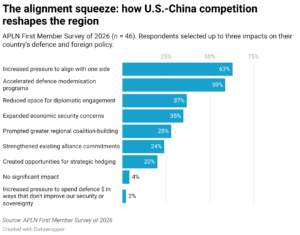
Figure 4. Impact of US-China strategic competition on national defence and foreign policy environments, as reported by APLN members (n = 46). Respondents selected up to three items.
Strikingly, only 24% selected ‘strengthened existing alliance commitments’ and 20% identified ‘created opportunities for strategic hedging’. If the US-China rivalry were producing positive security dividends, whether through stronger alliances or greater strategic flexibility, these figures would be substantially higher. Instead, the data describe a region under pressure to take sides and spend more on defence, without a corresponding sense that these adjustments are delivering greater security or diplomatic room to manoeuvre.
Only two respondents (4%) reported no significant impact, confirming that US-China competition is experienced as a pervasive structural condition across the region, not a concern limited to directly allied or frontline states.
Conclusion
Cyber threats to nuclear command and control drew the survey’s sharpest consensus. Nine in ten members rated their impact as destabilising. Over half went further, selecting “very negative,” a level of intensity unmatched by any other technology. Coming from a group that includes former heads of state, ambassadors, and military leaders with direct experience of nuclear command architecture, that finding carries weight. The practical implication is clear. Cyber-nuclear vulnerability is no longer a niche research topic and belongs on the RevCon agenda.
The 2026 NPT Review Conference opens against the backdrop of the landscape this survey describes. Members rank the resumption of nuclear testing and the erosion of arms control frameworks above any single state’s weapons programme. They report US.-China competition primarily as coercive pressure, not as something producing stronger alliances or more diplomatic space. And they cannot agree on whether the region’s existing institutions are worth fixing or need to be replaced. The common thread across all four findings is a widening gap between the nuclear risks the region faces and the institutional capacity available to manage them.
Three implications stand out for the 2026 Review Conference. Cyber-nuclear risk needs dedicated attention, not as a future concern but as one members already rank above AI in warfare. The arms control vacuum that members ranked highest suggests that even incremental outcomes at RevCon matter. Failing to show any forward movement risks confirming the institutional erosion that members already see. And the split over regional architecture is not a problem to resolve before RevCon but a question to bring into it. The region needs proposals that strengthen what works and build what is missing at the same time. APLN is well placed to develop them.
Download the full survey (PDF)
About the APLN Membership Survey
The survey was distributed to approximately 150 APLN members beginning in January 2026 via Microsoft Forms, with responses collected through March 2026. 47 responses were received; one duplicate response was identified and removed, yielding 46 valid responses (31% response rate). Respondents span at least 15 countries across the Asia-Pacific and include former heads of government, ambassadors, military leaders, and senior scholars. The respondent pool includes 10 ambassadors, 2 generals, 8 professors, and 15 holders of doctoral degrees. The survey employed a combination of Likert-scale assessments, ranking questions, multi-select questions, and open-text fields. Given the small sample size, results are not disaggregated by country or affiliation to preserve respondent anonymity. As an informal survey of a curated expert network results should be interpreted as an informed barometer of elite opinion rather than as statistically representative findings.
This analysis was prepared by APLN Policy Fellow Hree Putri Samudra, based on a survey conducted by APLN Senior Policy Fellow Joel Petersson Ivre. The APLN team is grateful to APLN members for their responses.
The next APLN Membership Survey is planned for October 2026.