
Loss and Containment: Asia-Pacific states and the exaggerated threat perceptions of the United States and China
EXECUTIVE SUMMARY
Download or print the full report
The United States and China exaggerate the influence that the other holds over states in the Asia-Pacific. Regional states are driven by far more considerations than US and Chinese interests, but instead of seeking to understand the policymaking of regional states, both the United States and China tend to rely on oversimplified interpretations of regional state policies. In Washington, these interpretations are driven by a fear of being pushed out of the region; in Beijing, they are driven by a fear of being contained within the region. The inability to recognise more nuanced explanations for third state behaviour only increases threat perceptions in both the United States and China. to reconceptualise
This report uses “fear” as a framing device the negative perceptions that the United States and China have of each other. It assesses US perceptions of and engagement with Southeast Asian states, and argues that the United States suffers from a deeply held fear of losing influence against China. By contrast, it analyses Chinese views and policies towards US allies, which have engendered a deep fear of US-led containment. The report does not argue that these fears are entirely misguided, but because the United States and China both underestimate the ability of regional states to assert their own agency against the other major power, their fears become significantly overstated.
Notable findings of this report include:
- The United States misreads Southeast Asian autonomy as alignment with China: Washington often interprets regional neutrality or hedging – especially by states like Malaysia and Indonesia – as evidence of Chinese influence, rather than independent policymaking. This “fear of losing” fuels confrontational and one-sided US engagement, which alienates Southeast Asian partners who are seeking balanced, autonomous relations with both powers.
- Southeast Asian states actively assert independence, not alignment: Countries such as Malaysia, Indonesia, and Vietnam pursue policies – on technology, defense, and international norms – that reflect their own national and regional interests, not allegiance to either China or the United States. Their behavior limits both Chinese and U.S. influence, showing that the region’s main dynamic is one of strategic autonomy, not great-power alignment.
- China’s fear of US containment is rooted in misperceptions of allied agency: Beijing interprets US alliances and partnerships in the Indo-Pacific – such as AUKUS, the Quad, and US–Japan–ROK cooperation – as deliberate instruments of containment, assuming allies are “pawns” of Washington. This overlooks the significant independence of these states, whose decisions are often shaped by their own domestic politics, threat perceptions, and regional concerns rather than US direction.
- US allies are balancing, not containing, China – and often for their own reasons: US allies like Japan, South Korea, and Australia pursue “measured containment” or balancing strategies to protect their autonomy and respond to Chinese coercive behavior, not merely to serve US aims. China’s inability to distinguish balancing from containment – and its reluctance to link regional reactions to its own actions – fuels its security anxieties and contributes to a self-fulfilling cycle of tension and alliance tightening.
These findings lead the report to make the following general recommendations to US and Chinese policymakers.
- Recognise the limits of each other’s influence: US and Chinese policymakers should avoid overestimating their rival’s control over regional dynamics and acknowledge that both face real constraints imposed by the independent choices of regional states. Accepting these limits would reduce mutual suspicions, correct false assumptions about “allies-as-pawns,” and promote more realistic, restrained strategies in the Asia-Pacific.
- Boost – don’t constrain – regional agency: The United States and China should allow Asia-Pacific states to set their own agendas and manage great-power influence on their own terms. This means engaging in genuine dialogue, avoiding coercive or unilateral policies, and supporting multilateral processes. Both powers should focus on enabling regional autonomy—by expanding diplomatic capacity, reducing economic coercion, and refraining from actions that undermine regional initiatives—rather than competing for dominance.
- Acknowledge regional agency unconditionally: US and Chinese policymakers should respect the independent choices of regional states even when those choices do not align with their own interests. Distinguishing between genuine alignment and constrained behavior is essential: smaller states in the region may sometimes be subject to coercion that aligns their policies with that of a major power in the short term, but such coercion breeds resentment and erodes long-term influence. Overexaggerating the effect of short term alignment and concessions could needlessly exacerbate the fear of losing and of containment.
About the Authors
Joel Petersson Ivre is Senior Policy Fellow at APLN.
Frank O’Donnell is Senior Research Adviser at APLN.
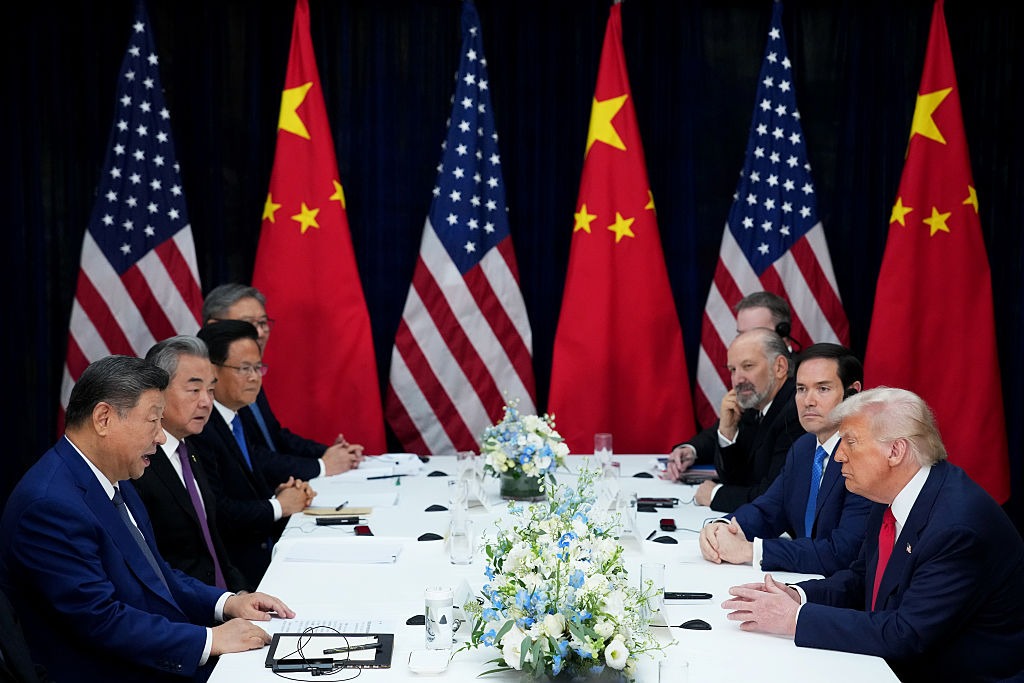
Image: President Donald Trump (R) speaks with Chinese President Xi Jinping during a bilateral meeting at Gimhae Air Base on October 30, 2025 in Busan, South Korea. Trump is meeting Xi for the first time since taking office for his second term, following months of growing tension between both countries. (Photo by Andrew Harnik/Getty Images)